THE MAKING / HALL OF SAINTS
Making
Hall of Saints.
Hall of Saints started with a strange design problem.
A Loot bag is eight lines of text: a weapon, chest, head, waist, foot, hand, neck, and ring. We wanted to turn those eight objects into a stained-glass window.
Not just one window, either. The artwork had to work as a system. Different weapons needed to occupy the same part of the composition, and the same was true for every other equipment slot. Whatever combination came out of a Loot bag still had to look like it belonged together.
I spent months figuring out what that system could look like, and eventually settled on stained glass, particularly 20th-century French designs with hard angles, strong geometry, and no etching.
What follows is some of the work behind it.
Artwork and design by Ticklish.
Project by raulonastool.
01
Starting conditions
The fact that so many Loot items have a material in their name led to a lot of research into textiles and metallurgy.
The industrial processes and biological origins of things like silk and linen suggested plenty of imagery. So did chemical bonds, mineral structures, and the physical forces that make one material different from another.
The vaguer terms gave me more room to play. Words like Divine, Hard, or Plated could be interpreted much more freely.
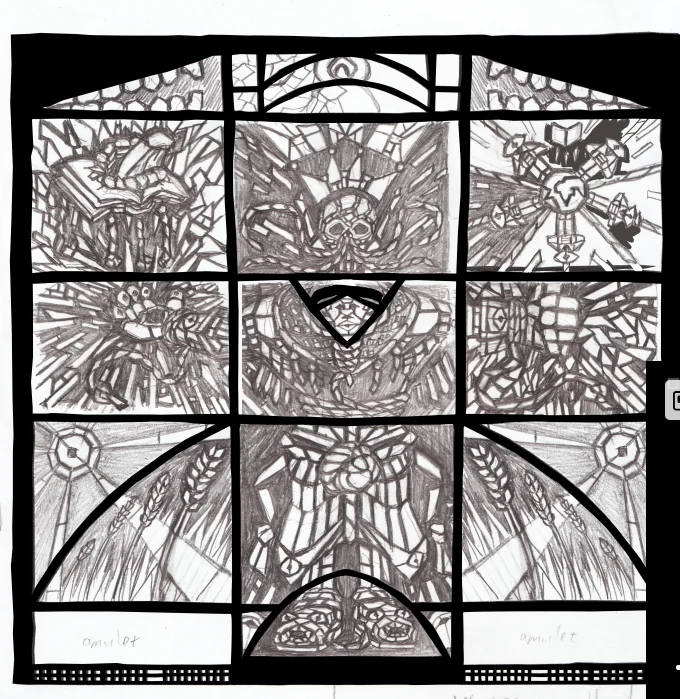
I also dug up books on alchemy and the occult. Those traditions developed dense visual languages for encoding information, meaningful to people who understood the symbols and fairly impenetrable to everyone else. Christian stained glass often works in a similar way. Once I started thinking about the Saints that way, the visual language began to open up.
The panes were drawn in pencil on a pre-printed template. I carried a clipboard of them around with me, and almost all of the items were drawn in public: on benches, in libraries, wherever I happened to be.
I only drew one item in a church.
That was enough to learn that vicars become incredibly excited when you show an interest in stained-glass windows and will not leave you in peace.
The existing Loot classes gave me another useful structure. Mages tend to carry certain items that distinguish them from Warriors or Hunters, so I started giving those groups their own associations.
Mages became linked with industry and technology.
Warriors leaned toward geology.
Hunters toward biology.
That gave each group a distinct character. It also meant that when a Saint crossed those boundaries, wearing metal armour while carrying a wand and a leather hood, they could look like someone who genuinely belonged to several different worlds.
02
Pieces of eight
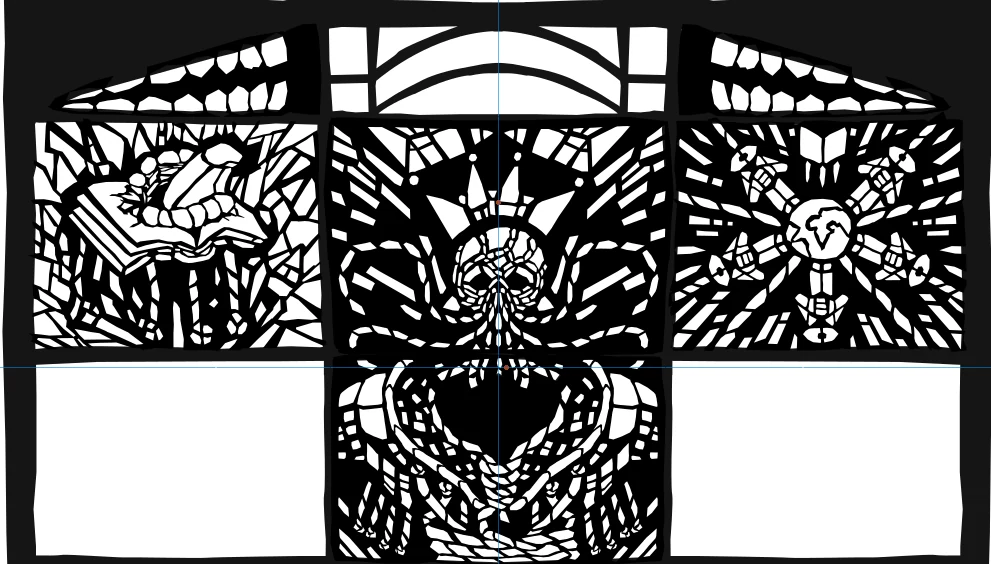
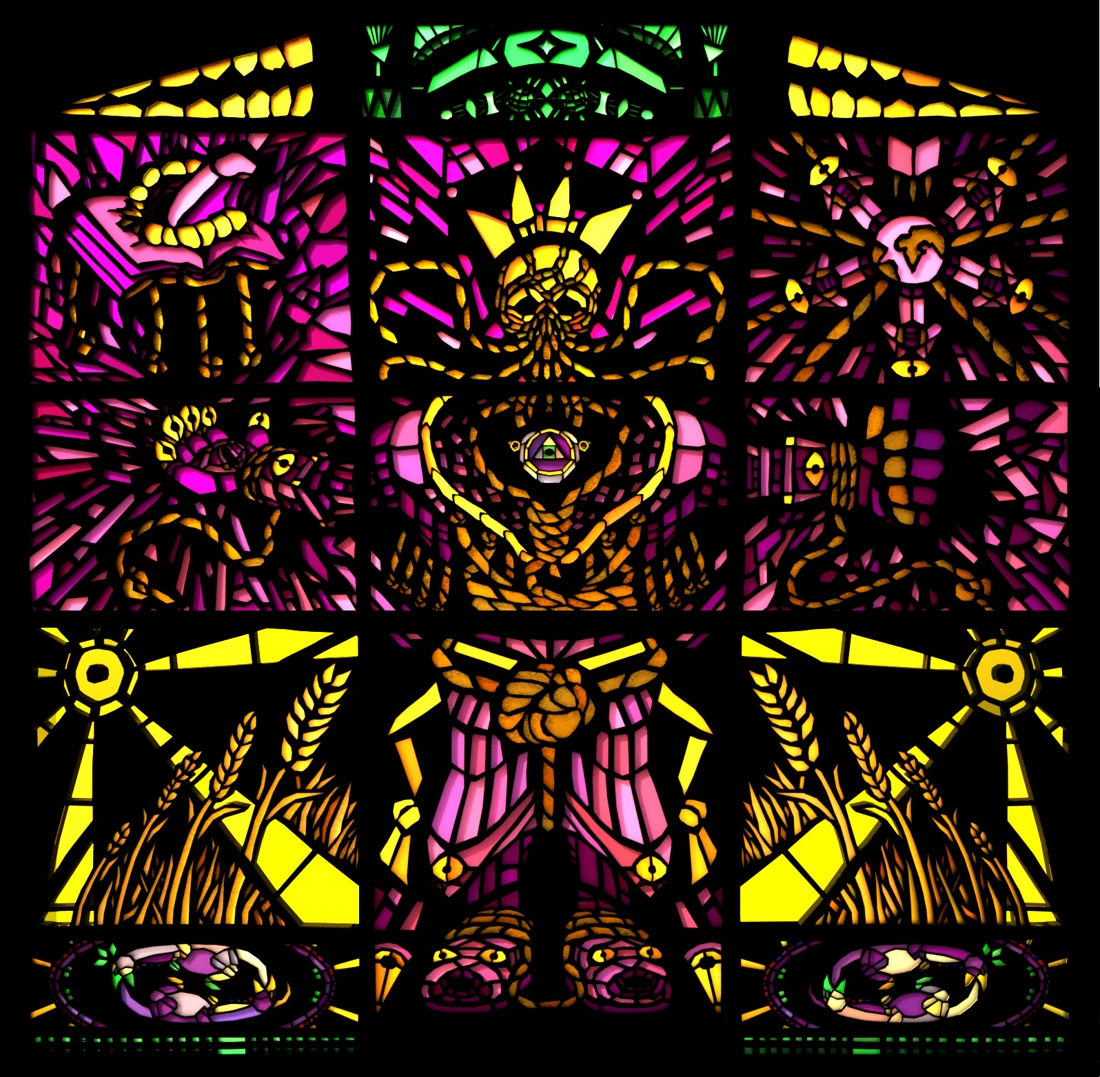
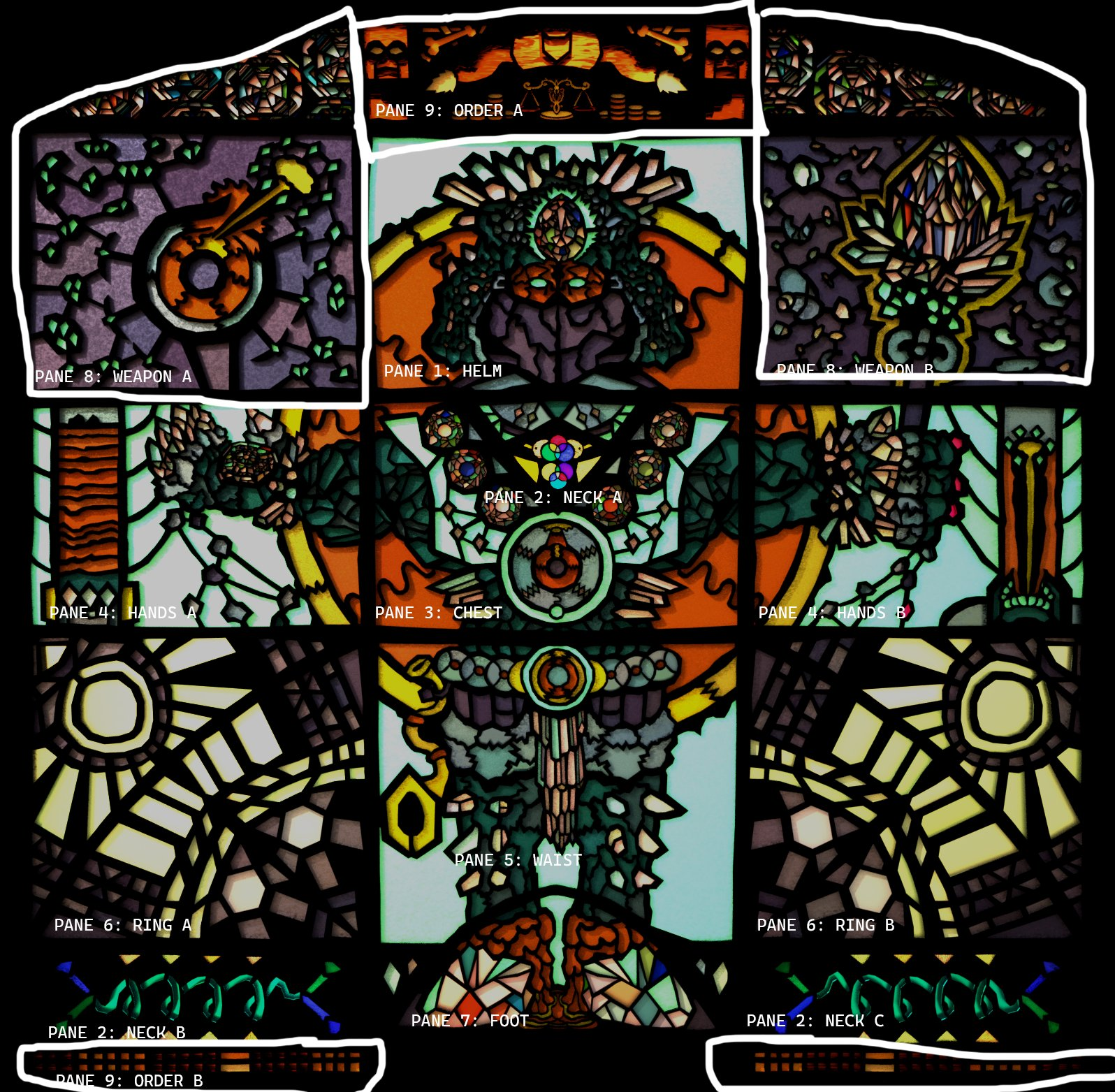
Every Saint is built from the eight items in a Loot bag.
The weapon has its part of the window. So does the chest, head, waist, foot, hand, neck, and ring.
That meant I was never really designing complete Saints one at a time. I was designing pieces that might eventually sit beside hundreds of other pieces I had no control over.
A sword had to work next to a robe it had never been designed beside.
A necklace might sit beside heavy armour.
Something delicate might end up next to something loud and strange.
The combinations came from Loot. I had to build a system that could survive them.
Presenting the items as panes in a stained-glass window is also different from the more common paper-doll approach to generative collections. The pieces do not overlap. Each pane has its own place, and the light behind them has to feel consistent across the entire window.
The items were originally designed in vertical groups. All of the silk items might appear together in one window, linen in another, and so on. Each family needed a clear internal logic.
Then those carefully organised windows would be scrambled.
The hope was that enough of the original logic would survive that scrambling to remain visible in the finished Saint.
I was also keen to give the Orders a larger role.
I had already been thinking about them while writing fiction for the Genesis Scrolls collection, and I wanted them to feel like more than rarity labels.
Both Ticklish and raulonastool wrote several short stories for Genesis Scrolls, a community storytelling project that eventually became Loot (for Adventurers), an illustrated anthology set in the Loot universe.
The Order most represented among a Saint's items becomes part of their title, with ties settled by a fixed rule. If none of the items carries an Order, the Saint has no Order affiliation.
I think of the Orders as human organisations with different beliefs about Loot and different ideas about what should be done with it. The Order of Fury, for example, is concerned with restorative justice. The Order of Vitriol is more interested in reductive materialism.
You do not need to know any of that to look at the artwork.
But the hints are there.
The idea is to leave enough behind that someone might start wondering who their Saint actually is, where their loyalties lie, what they believe, and what they are doing with all this Loot.
03
Light pours in
Once the drawings were finished, I scanned them, traced and refined them as SVGs, then brought them into Blender.
The SVGs could be extruded into physical window frames.
Around them I built a very simple church.
The window faces the sun, high in the sky.
That environment stayed fixed.
When I rendered different items, I swapped the window frames but kept the church, the camera, the sun, and the rest of the scene in place. That gave every pane the same underlying lighting conditions and made it possible for pieces rendered separately to still belong to the same window later.
Working out the glass itself was another education.
Blender's lighting engine can behave very naturally, but its material system also lets you do some fairly unearthly things with glass.
I kept the material palette strict within each group of items. Certain colours belong to certain ideas. That particular purple, for example, only appears on Divine things.
The 3D environment also gave me a way to treat +1 items differently.
They use the same frames and the same materials as their ordinary counterparts, but they are rendered under different lighting conditions.
I wanted them to feel immediately wrong.
Not damaged or corrupted.
More like they had entered the window from somewhere outside its reality.
04
Canonisation
A Loot bag begins as a list.
The Saint is where that list starts to look like a person.
By the time the eight items have become a figure surrounded by symbols, materials, Orders, colours, and all the associations buried inside them, there is already the suggestion of a character there.
So the Saints needed names.
Each one receives a name drawn from a long list, including a few references and homages that longtime Loot collectors may recognise.
Each name is also paired with an adjective.
That gives them an epithet.
And if they have an Order, that affiliation becomes part of their title as well.
None of this is meant to close the character off with a fixed biography.
It does the opposite.
The name, title, equipment, symbols, and Order give you a handful of clues.
The rest is yours to connect.
05
The archive
A lot of the work never appears in a finished Saint.
There are sketches, abandoned symbols, alternate compositions, Blender tests, colour studies, strange intermediate renders, and versions that existed only long enough to answer a question.
We kept them.
This page is a look through some of that pile.
It is not meant to be a clean timeline, and some of these images were never intended to be shown publicly. They are here because they show the work changing.
Some ideas became central to the Hall.
Others disappeared completely.
Both are part of how it got made.
Ticklish
Hall of Saints was created by Ticklish.
Visit Ticklish on X ↗